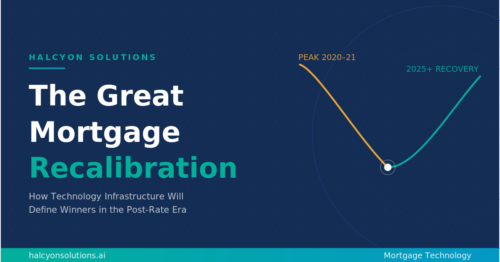
The mortgage industry is experiencing its most significant disruption since the 2008 financial crisis, but this time the threat is not subprime lending or regulatory backlash. It is technology. While traditional banks and credit unions have spent the past decade rebuilding capital and refining risk management, fintech mortgage companies have quietly captured 25% of total mortgage origination volume, according to the Mortgage Bankers Association’s latest industry report.
For community banks and regional lenders, this digital mortgage transformation represents more than competitive pressure. It is an existential challenge. Mortgage lending has historically been a cornerstone of community banking, generating both fee income and long-term customer relationships. When institutions lose mortgage market share, they do not just lose revenue; they lose the opportunity to establish deeper banking relationships with homebuyers who represent the most financially stable customer segment.
Industry data consistently shows that traditional banks have surrendered a significant share of conventional mortgage originations to non-bank lenders over the past several years. That ongoing shift signals not a gradual adjustment, but a structural realignment. The institutions that recognize this now and act on it will be the ones still writing mortgages a decade from now.
Mortgage Processing Speed: Where Traditional Banks Fall Behind
The fundamental competitive advantage fintech mortgage companies have established is not lower rates or looser underwriting. It is speed. A recent study by J.D. Power found that digital-first mortgage lenders can complete the entire loan process in an average of 32 days, compared to 47 days for traditional banks. More telling is the variance in processing times. While fintech lenders maintain consistent 30 to 35 day cycles regardless of loan complexity, traditional lenders see dramatic swings from 35 days for straightforward applications to 65 or more days for complex scenarios.
This speed differential translates directly into market share loss. In competitive housing markets where buyers need pre-approval letters within hours and closings within 30 days, a lender’s processing speed often determines whether they win or lose the business. Real estate agents, who control significant referral flow, increasingly steer clients toward lenders they trust to close on time.
Non-bank lenders, primarily fintech companies, have grown their share of the conventional origination market significantly over the past decade, while traditional banks have seen their share decline. The referral networks, builder relationships, and purchase market volume that historically belonged to community banks are being redistributed, and quickly.
Mortgage Technology Infrastructure: Why Banks Need Modernization
The speed gap between traditional lenders and fintech disruptors stems from a fundamental difference in technology architecture. Most community banks and credit unions still operate mortgage origination systems built in the 1990s and early 2000s. These systems were designed for a paper-based world where loan officers collected documents manually, underwriters reviewed files sequentially, and closing coordination happened via phone calls and fax machines.
Fintech mortgage companies, by contrast, built their systems from scratch with digital-first assumptions. Their platforms integrate automated income verification, credit decisioning algorithms, electronic document collection, and API-based third-party service coordination. The result is a streamlined process where borrower information flows automatically between systems, reducing manual handoffs and processing delays.
The infrastructure gap becomes particularly evident in document management and verification. Traditional lenders typically require borrowers to submit income documents, bank statements, and tax returns through secure portals, then route these files through multiple internal systems for review. Each system transfer introduces potential delays and data entry errors. Fintech lenders, however, use automated verification services that pull income and asset data directly from employers and financial institutions, eliminating both the document collection burden and manual verification steps.
Solutions like Halcyon’s
TrueTax™ directly address this gap. TrueTax replaces the antiquated 4506-C process with direct IRS integration, delivering instant, multi-year access to taxpayer data. Instead of waiting 10 or more days for forms that may be rejected due to errors, lenders receive verified income data in real time, eliminating manual document collection and accelerating the loan process. For self-employed borrowers and complex income scenarios,
TrueCalc™ pairs seamlessly with TrueTax to automate income calculations using AI-powered document processing, reducing underwriting time by up to 80%.
Industry research consistently shows that traditional mortgage lenders spend significantly more manual labor hours per loan application than their digitally optimized counterparts. That operational gap directly enables fintech companies to offer faster processing times while maintaining healthier unit economics.
Regulatory Compliance: The Hidden Competitive Disadvantage
Paradoxically, traditional lenders’ extensive compliance infrastructure, built to satisfy banking regulators, has become a competitive disadvantage in the mortgage market. Bank and credit union mortgage departments must navigate not only mortgage-specific regulations such as TRID, QM rules, and fair lending requirements, but also broader banking compliance frameworks including BSA/AML, CRA, and safety and soundness requirements.
This dual regulatory burden creates process complexity that fintech mortgage companies, operating under different regulatory frameworks, can avoid. While non-bank mortgage lenders must comply with mortgage regulations, they are not subject to banking examination procedures or capital requirements that add operational overhead.
The compliance complexity manifests most clearly in loan pricing and decisioning. Traditional lenders often require multiple approval layers, including loan officers, underwriters, compliance officers, and sometimes loan committees, before finalizing loan terms. Each approval stage introduces potential delays, particularly for non-standard loan scenarios that require manual review.
Identity verification is another area where compliance overhead slows lenders down. Halcyon’s
TrueYou™ provides instant, multi-point identity validation against trusted databases, delivering audit-ready KYC/AML certification that satisfies regulators without adding manual review cycles. Paired with
TrueMark™, which combines government-issued ID scanning with legally compliant e-signatures, lenders can meet rigorous compliance standards while creating a seamless digital experience for borrowers.
Research on community bank operations consistently confirms that smaller institutions spend a disproportionate share of their time and resources on compliance relative to non-bank competitors. This time investment, while necessary for regulatory compliance, directly impacts processing speed and borrower experience.
The Customer Experience Evolution
Today’s mortgage borrowers, particularly millennials and Gen X homebuyers who represent 75% of purchase applications, expect digital experiences comparable to other major financial transactions. They want real-time application status updates, mobile document upload capabilities, electronic signatures, and transparent communication about loan progress.
Traditional mortgage processes, however, often rely on loan officer relationships and phone-based communication. While this personal touch can be valuable for complex scenarios, it becomes a friction point for straightforward transactions where borrowers prefer self-service capabilities.
The experience gap is particularly pronounced in the pre-approval and rate lock processes. Fintech lenders typically offer instant pre-approval letters based on automated income and credit verification, while traditional lenders may require 24 to 48 hours for loan officer review and approval. In competitive markets where multiple-offer scenarios are common, this timing difference can determine whether buyers can submit competitive offers.
Digital mortgage platforms also provide borrowers with transparency that traditional processes often lack. Automated status updates, document checklists, and estimated closing timelines reduce borrower anxiety and loan officer inquiry volume. Halcyon’s
TrueReport™ extends this advantage even earlier in the process, enabling lenders to identify and pre-qualify high-value prospects with verified income data before a loan application is even submitted. Traditional lenders operating with legacy systems that do not provide real-time status information struggle to offer comparable transparency without significant manual effort.
Mortgage Digital Transformation: Complete Infrastructure Modernization
The solution for traditional lenders is not simply purchasing new software or adding digital front-ends to existing processes. Effective mortgage transformation requires rethinking the entire origination workflow, from initial application through post-closing quality control.
This comprehensive approach is where specialized transformation partners become critical. Successfully modernizing mortgage operations requires expertise in banking regulations, integration with existing core systems, staff training, and change management.
This is exactly the challenge Halcyon Solutions was designed to address. Rather than forcing institutions to replace their entire technology stack, Halcyon’s Mortgage Digital Platform creates a middleware layer that digitizes and automates the mortgage process while integrating with existing core banking systems, loan origination software, and compliance tools.
When a Halcyon client, a $2.8 billion community bank in the Midwest, faced declining mortgage market share due to processing delays, the bank partnered with Halcyon to implement comprehensive digital mortgage capabilities. The transformation involved automating income verification with TrueTax, implementing electronic document collection, integrating automated underwriting systems with TrueCalc, certifying borrower identities through TrueYou, securing digital closings with TrueMark, and creating real-time status dashboards for both borrowers and staff. Results are based on the actual implementation and are representative of outcomes achievable with proper execution.
The results were immediate and measurable. Average processing time dropped from 52 days to 34 days within 90 days of implementation. More importantly, the bank’s mortgage application volume increased 47% year-over-year as real estate agents began referring more clients, attracted by reliable closing timelines. The bank also achieved a 34% reduction in manual processing costs while maintaining rigorous compliance standards.
The key to this transformation was Halcyon’s approach to preserving what works while modernizing what does not. Instead of eliminating loan officers or abandoning relationship-based service, the platform enhanced these human touchpoints by providing staff with better tools and borrowers with more transparency. Loan officers could focus on relationship building and complex problem-solving rather than document collection and status updates.
Frequently Asked Questions About Mortgage Digital Transformation
How long does digital mortgage transformation take for banks?
Most community banks can implement comprehensive digital mortgage capabilities within 90 to 120 days with proper planning and specialized expertise. The timeline depends on existing system integration requirements and staff training needs.
What is the average cost of mortgage technology modernization?
Costs vary significantly by institution size, the number of systems requiring integration, and the scope of the transformation. Rather than a fixed price, community banks should evaluate technology partners on total cost of ownership relative to projected efficiency gains and loan volume growth. Most institutions reach break-even well within the first two years of deployment.
Can community banks compete with fintech mortgage companies?
Yes. When properly equipped with digital capabilities, community banks can match fintech processing speeds while leveraging relationship banking advantages that fintech companies cannot replicate.
What ROI can banks expect from mortgage digital transformation?
ROI depends on current processing costs, loan volume, and the depth of automation achieved. The most consistent gains reported by institutions that have completed digital transformations include meaningful reductions in per-loan processing time, lower manual labor costs per origination, and increased application volume as referral partners gain confidence in closing timelines. Institutions should model projections against their own baseline metrics rather than apply industry averages.
Next Steps for Mortgage Digital Transformation
The mortgage industry transformation is not slowing down. Fintech lenders continue gaining market share and operational scale, and the institutions that modernize now will be the ones positioned to compete a decade from now. For traditional lenders, the choice is clear: modernize mortgage operations to compete on speed and experience, or accept continued market share erosion.
As mortgage lending becomes increasingly digital and competitive, community banks and credit unions need partners who understand both the technology requirements and the banking industry context. Institutions ready to reclaim their mortgage market position should explore how Halcyon’s proven digital transformation approach can accelerate their competitive response while preserving their community banking strengths.
To learn how Halcyon Solutions can help your institution modernize mortgage operations and compete effectively against fintech disruptors, visit
www.halcyonsolutions.ai or contact our team to discuss your specific transformation goals.
Bibliography
Mortgage Bankers Association. “Mortgage Origination Market Share Analysis – Q3 2024.” MBA Research and Economics Department.
https://www.mba.org/news-research-and-resources/research-and-economics/single-family-research/mortgage-origination-estimates
J.D. Power. “2024 U.S. Primary Mortgage Origination Satisfaction Study.” J.D. Power Financial Services Intelligence.
https://www.jdpower.com/business/press-releases/2024-us-primary-mortgage-origination-satisfaction-study
National Association of Realtors. “Home Buyers and Sellers Generational Trends Report.” NAR Research Division.
https://www.nar.realtor/research-and-statistics/research-reports/home-buyer-and-seller-generational-trends
PitchBook. “Mortgage Technology Venture Investment Analysis – 2024 Year End Report.” PitchBook Emerging Technology Research.
https://pitchbook.com/news/reports/2024-mortgage-technology-venture-capital-trends